



RAAC Risk Categories Explained: Making Defensible Decisions About Buildings with RAAC
- Wed, September 30, 2026
- by Demi Keeble
When RAAC Is Found, What Happens Next?
When Reinforced Autoclaved Aerated Concrete (RAAC) is identified in a building, one of the first questions building owners ask is simple: how serious is it? The answer lies in the outcome of a RAAC risk assessment.
Across the UK, engineers, local authorities, NHS Trusts, housing providers and commercial building owners are using risk categorisation frameworks to understand the condition of RAAC structures and determine what action, if any, is required. These categories help translate technical survey findings into practical decisions about building safety, occupancy, monitoring, and remediation.
Importantly, the presence of RAAC does not automatically mean a building is unsafe. Equally, the presence of RAAC cannot be ignored. The challenge is understanding where a building sits on the risk spectrum and what that means in practice.
This guide explains how RAAC risk categories are used, what they tell us about a building’s condition and how they support informed decision-making for building owners, insurers and duty holders.
What Are RAAC Risk Categories?
Risk categories are used to communicate the condition of RAAC and the level of concern associated with it. They provide a structured way of interpreting survey findings and help building owners understand the implications of those findings. Rather than reducing complex engineering assessments to a simple pass or fail outcome, risk categories recognise that building conditions exist along a broad spectrum. Risks are categorised in line with the latest IStructE guidelines to provide a uniform, evidence-based assessment that can be understood by engineers, building owners, and operators.
Some RAAC structures remain in relatively good condition and can continue in service with appropriate monitoring. Others may require remediation, additional investigation, or temporary measures to reduce risk. In the most serious cases, immediate intervention will be necessary.
The purpose of categorisation is not to create alarm. It is to enable proportionate decision-making based on evidence.
Why Buildings with RAAC Can Have Different Risk Profiles
One of the biggest misconceptions surrounding RAAC is that all affected buildings present the same level of risk, but in reality, no two buildings are exactly alike. RAAC was used in a wide range of building types over several decades, and design details and construction quality vary considerably. As a result, two buildings constructed at the same time using similar RAAC planks can produce very different survey findings, especially if maintenance schedules and protocols have been different.
So, the condition of the material itself is only part of the picture. Engineers must also consider how the building is used and what the consequences of failure might be. A deteriorated roof plank above a busy public area presents a completely different level of risk than a similar defect in a rarely accessed part of the building. Occupancy, access arrangements, and building function all influence the overall risk profile. This is why risk assessments require more than simply confirming the presence of RAAC.
How Engineers Assess RAAC Risk
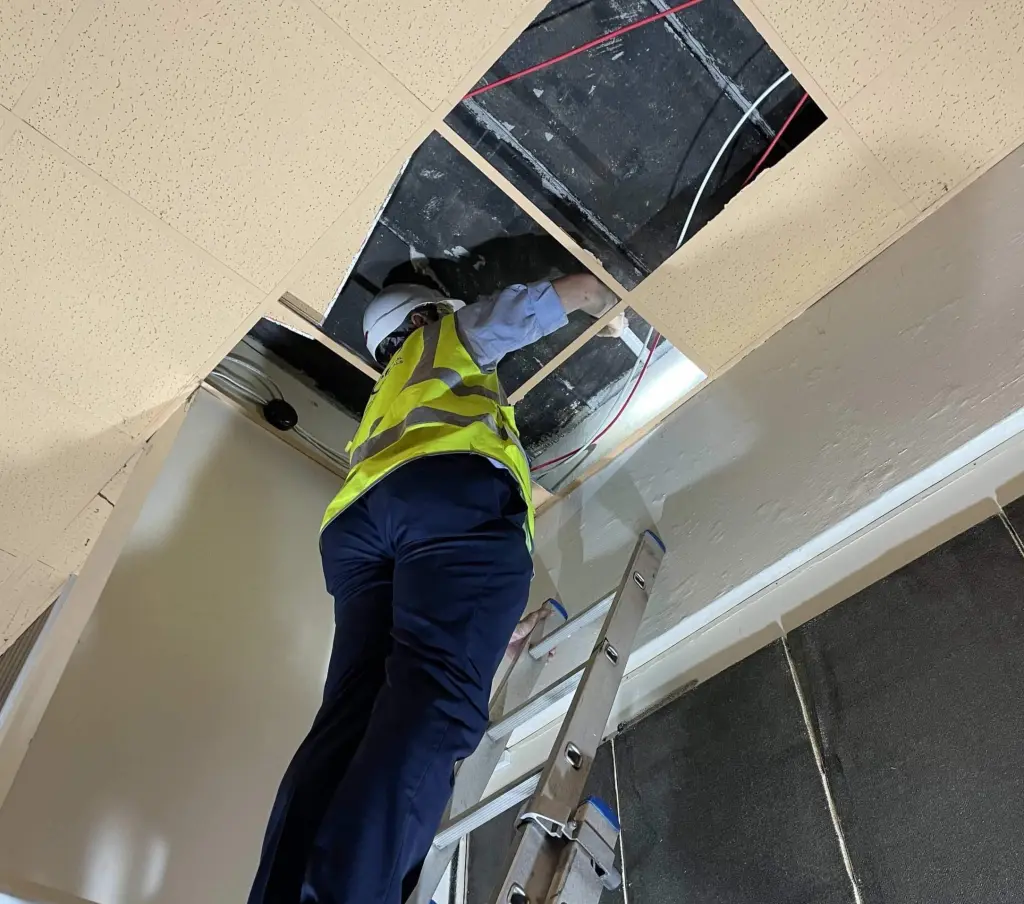
A RAAC survey is designed to establish not only where RAAC is present, but also its condition and context. Engineers typically assess a range of factors including:
- Water ingress and evidence of moisture exposure
- Cracking, deflection or distortion
- Bearing conditions and support arrangements
- Reinforcement condition
- Previous repairs or alterations
- Structural redundancy
- Accessibility and occupancy levels
- The potential consequences of failure
Taken together, these factors provide a clearer picture of the structural condition of the RAAC, and the risks associated with it. Engineering judgement plays an important role throughout the process, particularly when assessing why panels have deteriorated in the way they have. Risk assessment is not simply a matter of recording defects - it involves understanding how those defects interact with the wider structure and how they may affect the safe use of the building.
How RAAC Risk Categories Are Determined
Risk categories are based on the findings of surveys, inspections, and structural assessments. Although individual frameworks may vary, the underlying principle remains consistent. Buildings are categorised according to the level of risk presented by the condition of the RAAC, and the consequences should a failure occur.
At the lower end of the scale are buildings where RAAC remains serviceable, and risks are considered manageable through monitoring and routine inspection.
As evidence of deterioration, uncertainty, or structural concern increases, higher risk classifications may be assigned. These classifications help determine whether additional investigations, temporary works, access restrictions, or remediation measures should be considered.
Importantly, a risk category is not necessarily permanent. The condition of RAAC can change over time. Further investigations may reveal new information. Remediation works reduce risk. Ongoing monitoring may identify deterioration that requires reassessment. Risk categorisation should therefore be viewed as part of an ongoing management process rather than a one-off exercise.
Why Risk Categories Matter for Building Owners
For building owners and asset managers, risk categories provide a framework for making decisions that are both practical and defensible. The discovery of RAAC often creates pressure from multiple directions. Safety considerations must be balanced against operational requirements, financial constraints, and stakeholder expectations. Closing a building unnecessarily can have significant consequences. Delaying action where genuine risks exist can have even greater consequences.
Risk categorisation helps organisations navigate those competing pressures by providing a structured evidence base for decision-making. It enables resources to be prioritised, remediation programmes to be planned, and risks to be managed proportionately. Perhaps most importantly, it provides a clear rationale for why particular decisions have been taken.
RAAC Risk Assessment in Practice: The Medway Example
The Gun Wharf project for Medway Council demonstrates how risk categorisation supports informed decision-making. The council headquarters contains a substantial pitched RAAC roof structure, a configuration that differs from the flat roof arrangements more commonly associated with RAAC.
Initial investigations identified a number of questions regarding the condition and behaviour of the structure. Rather than relying on assumptions, Medway Council commissioned a detailed programme of investigation involving RCS, Loughborough University, and BRE.
Surveying, testing, and structural analysis provided a far more detailed understanding of the building than visual inspection alone could have achieved. The outcome was not a simplistic decision to close the building or remove all RAAC. Instead, the evidence allowed the council to evaluate risk, consider mitigation measures, and develop an informed long-term strategy for the building.
The project illustrates an important principle. The objective of a RAAC assessment is not simply to identify problems. It is to generate the evidence required to make proportionate decisions.
RAAC and Insurance Risk
As awareness of RAAC has increased, insurers have taken a greater interest in how affected buildings are being managed. For insurers, the key question is not simply whether RAAC exists within a building. The more important question is whether the associated risks are understood and controlled.
A building that has been comprehensively surveyed, assessed and monitored by engineers with appropriate knowledge and experience presents a very different risk profile from one where little is known about the condition of the structure. Risk assessments, inspection records and documented management plans can all form part of the evidence demonstrating that risks are being actively managed. For many organisations, engineering evidence is becoming an increasingly important part of conversations with insurers.
The Role of Duty Holders and Building Safety Responsibilities
Although RAAC is an engineering issue, the implications extend beyond structural assessments. Those responsible for managing buildings have wider duties relating to health and safety, risk management, and governance. Understanding the condition of a building and responding appropriately to identified risks forms part of those responsibilities to protect the people working within. Often, the impact on people may not be through a direct impact from RAAC but instead could be a consequential issue. For instance, if a RAAC panel falls on asbestos or plant, the users could be impacted away from the point of failure.
Most buildings contain risks that require management. The challenge is rarely the existence of risk itself. The greater concern arises when risks are not properly identified, assessed, or addressed.
A documented process of investigation, assessment and decision-making provides a clear audit trail and demonstrates that actions have been based on evidence rather than assumption.
What Happens After a RAAC Risk Assessment?
A risk assessment is not an end point. Once a building’s condition has been established, attention turns to determining the most appropriate response.
That response may involve continued monitoring, additional investigation, remediation works, temporary measures or changes to how parts of the building are used. The right approach depends on the evidence available and the specific circumstances of the building.
This is why risk categorisation matters. It helps translate technical findings into appropriate practical actions. It helps building owners understand their options. It provides insurers and stakeholders with confidence that risks are being managed appropriately. Most importantly, it supports informed decision-making.
The discovery of RAAC inevitably creates uncertainty. The purpose of risk assessment is to reduce that uncertainty and provide a sound basis for deciding what happens next.
Need advice on RAAC risk assessment?
RCS provides an end-to-end service covering surveying, testing, structural assessment, options analysis and solution implementation for buildings containing RAAC. To discuss a project or arrange an initial conversation, contact the team.
Further Reading
This article is part of RCS’s guide to managing RAAC in buildings. The series explores how engineers assess risk, how building owners make informed decisions following the discovery of RAAC, and the practical considerations surrounding insurance, liability, occupancy and remediation. Together, these articles explain how evidence-led engineering can reduce uncertainty and support proportionate responses to RAAC.
Frequently Asked Questions
Below are answers to some of the most common questions about RAAC risk assessments. If you can't find the information you're looking for, please get in touch with our team.
What are RAAC risk categories?
RAAC risk categories are classifications used by engineers to assess the condition of Reinforced Autoclaved Aerated Concrete and the likelihood of structural failure. They help building owners understand risk levels and determine what actions may be required.
Does finding RAAC mean a building must close?
No. The presence of RAAC does not automatically mean a building is unsafe or must close. The appropriate response depends on the condition of the RAAC, the level of risk identified, and the findings of a structural assessment.
How is RAAC risk assessed?
RAAC risk assessments typically consider factors such as plank condition, water ingress, bearing arrangements, reinforcement corrosion, cracking, deflection and the potential consequences of failure.
What is considered High Risk RAAC?
High Risk RAAC generally refers to structural elements showing significant deterioration, defects or uncertainty that may require mitigation measures, further investigation or restrictions on building use.
Can a RAAC risk category change?
Yes. A building’s risk category can change over time. Deterioration may increase risk, while remediation works, monitoring or structural interventions may reduce it.
Why are insurers interested in RAAC surveys?
Insurers often require evidence that buildings containing RAAC have been properly investigated and assessed. Survey findings and risk assessments help demonstrate that risks are understood and managed appropriately.
